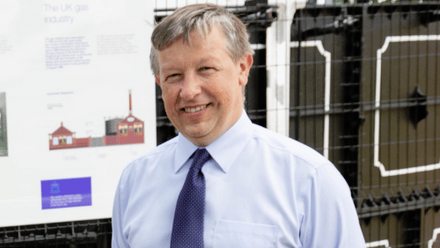
Charles McAllister answers your #BurningQuestions on green gas

In this edition of #BurningQuestions, Charles McAllister, Director of the Green Gas Taskforce, tackles key questions on the future of biomethane in the UK. From sustainability and policy to public perception and skills, Charles offers insights on the role green gas can play in achieving net zero.
The Taskforce is a campaign group which was set up to make the case for the greater use of biomethane and other green gases in GB. Taskforce partners include the largest biomethane producers, shippers and traders, all of the GB gas networks and four key sector groups.
Q: On environmental impact: What are the key challenges in ensuring biomethane is truly sustainable long-term?
A: Biomethane is a sustainable low carbon fuel made from a variety of waste and agricultural sources. The Taskforce partners completely understand that the growth in the sector must ensure sustainably sourced feedstocks over the long term.
The Taskforce commissioned an independent assessment of the potential for biomethane out to 2050. This report, by Alder BioInsights, concluded that Great Britain could generate 120 TWh of biomethane by 2050 without negatively impacting food production and without competing with feedstocks for other synthetic fuels such as sustainable aviation fuel (SAF) production. This means better energy security and a low carbon domestically produced gas supply.
Increased biomethane generation means better waste management, water quality improvements and better soil carbon retention. At present only 2.5% of the UK’s available organic farm waste is used to create biomethane, making it a relatively untapped resource of green fuel with enormous potential. With the UK’s gas import dependency set to exceed 70% by 2030, reliance on carbon intensive imports for decades is not sustainable long term.
Q: On Policy: What policy changes are most urgently needed to accelerate green gas deployment in the UK?
A: The Green Gas Taskforce has a list of policy changes which would deliver a step change in the sector. The four most important are:
- Government should set a target for biomethane generation out to 2035 and 2050
- Biomethane should be properly accounted for on the Emissions Trading Scheme (ETS), as is the case in other European nations. At present, biomethane is treated the same as natural gas in the ETS even though it is renewable and low carbon.
- The bi-products of biomethane generation, Bio-CO2 and digestate, should be valorised. High quality and pure Bio-CO2 produced from anaerobic digestion can be used in food production and for greenhouse gas removals – making biomethane carbon negative. Digestate can be used as a like for like replacement for synthetic fertiliser, 100% of which is imported in the UK.
- Government should adopt a long-term support mechanism, as has been recently called for by NESO. This would ensure a consistent pipeline of new generation projects.
Q: For future: Do you think green gas could completely replace natural gas in the UK gas grid? Why or why not?
A: Biomethane is a versatile fuel and is interchangeable with natural gas, meaning that as a ‘drop in’ fuel – it can be injected into GB’s world class gas network with no change in experience for the end user.
We are quite clear that biomethane cannot do everything, i.e. it cannot be used to decarbonise all parts of the UK economy. It is a choice of where is best for the biomethane to go. The Taskforce is not taking a position on where biomethane should go, that is a decision for Government and for the market.
Biomethane can be used to decarbonise power generation and in doing so help achieve Clean Power 2030, or it could also be used to decarbonise industrial gas demand, such as the supply agreement between Future Biogas and Astra Zeneca that is the UK’s first unsubsidised biomethane to gas grid plant.
Today, biomethane generation capacity is sufficient to heat and decarbonise around 1 million homes in GB, delivering more home heating emissions reductions than any other technology. If every home on the gas grid had a hybrid heat pump boiler system, home heating gas demand would be approximately 57 TWh, meaning biomethane generation could meet that with spare supply for other sectors. NESO have said clearly that ‘natural gas, biomethane and hydrogen will co-exist in the future energy system’, a view which the Taskforce agrees with.
Q: How close are we to seeing biomethane become a standard part of the grid mix, and what does that mean for training or safety standards?
A: Biomethane generation capacity currently sits at around 11 Twh from 130 plants – for context this is enough to heat and decarbonise around 1 million GB homes. Biomethane is already integrating seamlessly into the GB gas grid and is forecast to grow. NESO have said that they expect to set at least 64 TWh of biomethane by 2050 in their holistic transition scenario and the Green Gas Taskforce commissioned assessment has concluded that 120 TWh of biomethane can be delivered by 2050 sustainably and without negatively impacting food production. In the NESO scenario that means biomethane makes up over a third of GB gas supply.
We expect the GB gas grid to be a blend of green gases such as biomethane, hydrogen and natural gas out to 2050 and beyond. We are campaigning for as much of that as possible to be domestically produced green gas of course. As the level of green gas supply increases, there is a big opportunity to broaden the skills base for gas workers across the country, such as consideration of compression and capacity requirements, calorific value considerations and grid connection needs. The GB gas network has an outstanding safety record, backing by thousands of skilled gas engineers and a successful maintenance of the gas network will see these workers retained for decades. Engineers working with natural gas today will experience no material difference when working with biomethane.
Q: Could you explain how biomethane compares to hydrogen in terms of scalability and long-term sustainability?
A: Biomethane and hydrogen are both low carbon gases which offer huge opportunities as the UK transitions to a net zero economy. As already referred to, NESO have articulated in FES25 that biomethane, hydrogen and natural gas will co-exist in the future energy system, and so we need scaling of both biomethane and hydrogen. Biomethane is ready now as a proven and scalable fuel source. Hydrogen has the potential to play a huge role in the future, including market-enabling hydrogen blending in the near term, with a variety of production sources such as green and blue hydrogen being supported by Government policy and a particular focus within industrial clusters.
Q: With so many competing priorities in decarbonisation, what role do you see biomethane playing in the UK’s net zero strategy, and how do we make the policy case to ensure it’s not overlooked?
A: The Green Gas Taskforce’s key role is to make the case for biomethane and other green gases in the transition to net zero. We are doing that as a collective of generators, networks and sector groups, all pushing for a common goal with a consistent message. We are seeing real momentum. The Taskforce does this in two ways; firstly, increasing the profile of biomethane with the public and policymakers and therefore raising the awareness of the technology, and secondly providing clear evidence on the policy changes that need to take place in order to unlock the growth of the sector.
In terms of the role of biomethane in the UK’s net zero strategy, biomethane, like all gases, is a versatile fuel with a range of potential end uses. Biomethane can continue to be used to decarbonise home heating for example. If all of the 120 TWh in 2050 went to home heating, green gas could decarbonise almost half of the GB housing stock on the gas network. If all of GB’s gas grid homes had a hybrid heat pump-boiler system, less than 60 TWh of the future biomethane generation would be required to provide the gaseous heat demand required.
Biomethane can be used to decarbonise power generation, such as when there is a need for dispatchable backup generation during dark, low wind periods. Green gases can play a key role in delivering the government’s Clean Power 2030 mission by leveraging existing gas fired power generation capacity fuelled with low carbon biomethane. Biomethane can decarbonise transport, especially HGVs which do not have a readily available low carbon alternative, other than biomethane.
Finally, biomethane can decarbonise industry. Many industries such as glass, steel and paper have recognised the need for gas under any decarbonisation scenario. These industries want a low carbon, cost effective means of decarbonising their gas use today, and biomethane is one of the best options available to do so.
Q: There’s still a lot of public confusion about green gas. How can we better communicate its benefits and reassure customers about its safety and reliability?
A: Energy literacy is a key issue across the public and policymakers alike, and the energy debate has become increasingly politicised. The gas network operates silently and invisibly at a reliability rate of 99.99%. It truly is a national asset, but most people don’t understand the extent of it, never mind its functionality. Communication of the merits of green gas, and gas as a fuel more broadly, should be delivered as simply as possible. We need it, and we will continue to need it, and the merits of producing it here outweigh the import alternative.
On biomethane specifically, given it can be used interchangeably with natural gas there is a very strong message to consumers – you don’t have to change anything, and you won’t notice any change. The transition from natural gas use to biomethane use is seamless to end users.
We understand that there is a lack of literature on the case for biomethane, and this is one of the key reasons the taskforce was set up. We are in the process of releasing a series of reports which will provide the literary firepower to demonstrate its benefits and reassure customers as to the safety, reliability and the merit of greater use of green gases. As an early snapshot, we will be releasing reports in the next few months which examine the feedstock availability for biomethane, the economic case for biomethane, the potential for biomethane in transport and the greenhouse gas removal opportunity from biomethane. Keep your eyes peeled!
Q: What advice would you give to someone just starting out in the industry who’s passionate about renewable gas?
A: My three key pieces of advice are;
- Show your passion. Be loud and proud about the merits of green gases, whether that’s in conferences or in the pub.
- Strive for more understanding. This is a complex system which delivers energy to every corner of the nation, and there are always opportunities for learning more about how it functions and opportunities to improve it. The industry is packed full of friendly, approachable and intelligent people who actively embrace innovation and ideas.
- Don’t spend all of your effort trying to convert the converted. It’s easy to convince people in an echo chamber – actively embrace the opportunity to speak in an environment where you may face opposition. Doing so also improves how you present your case.

![flame [canva] 1](https://www.igem.org.uk/static/9ef0e82e-1c6c-4c0b-a1c7c8f3f88e1153/resourcegridlistingimagedefault_4d12532919c64e60a22baf03232bbf94_4a7c7e45a350/flame-canva.png)


![engineer 2 [freepik]](https://www.igem.org.uk/static/6257d50c-cc26-460d-82567e651e92be97/resourcegridlistingimagedefault_4d12532919c64e60a22baf03232bbf94_4a7c7e45a350/engineer-2-freepik.png)