
The UK’s gas networks are often seen as coming into their own during the winter. This common perception is, in many ways, true. The networks transport gas to millions of homes and businesses, helping to keep people warm during the cold winter months. And in a power system which has seen rapid increases in wind generation over the past 25 years, gas has been relied on more than ever to balance out lower wind periods, particularly during Dunkelflaute (an extended period of low wind and low sun).
Indeed, due to the combined effects of coal phase out, lower output from our nuclear fleet and the realities of intermittent renewables, there are times in recent winters where gas has produced a greater proportion of our electricity needs than it did even before the start of the UK’s renewables journey.
But winter is rapidly becoming only part of the gas story. On 30 June this year – when Britain was in the midst of an intense and record-breaking heatwave – gas produced 353 GWh, or 50% of all electricity. To put this in perspective, wind, solar and imports totalled 198 GWh of electricity on this day; 44% less than gas.
What is Hitzeflaute?
So why is this happening? The answer lies in Dunkelfaute’s rather sunnier cousin - Hitzeflaute, a German term that loosely translates to ‘heat lull’. During a Hitzeflaute, very hot temperatures combine with windless conditions, producing the sort of heatwaves we’ve seen over the course of this summer.
New FEN analysis shows that there were four Hitzeflaute periods between May and the middle of August 2026, the same number as over the same period in 2025. While the number of days might be the same, the weather and heat intensity were far greater in 2026 compared to 2025.
This is borne out by the data on cooling degree days (CDD), a weather metric that indicates demand for cooling by tracking for how long temperatures rise above a standard baseline. A total of 67.4 CDDs were recorded in central London over the period in question this year – more than five times as many as the 12 registered in 2025.
The changing energy mix
This extreme weather creates a perfect storm. Demand for electricity increases as people plug in fans or air conditioning units, while wind generation drops dramatically. Solar power makes a big contribution during the day, but this falls away quickly when the sun goes down. Gas is heavily relied upon both to make up for the shortfall in power generation caused by the windless conditions, and to provide the flexibility needed to ensure power system stability as the sun sets.
The charts below, based on the latest FEN research, show just how dramatic this surge in gas generation can be; using the rounded daily averages, gas generated 73% more electricity during Hitzeflaute periods than on other summer days.
These numbers show that wind and imports together fell by 108 GWh, while gas increased by 108 GWh. So, gas didn’t simply replace wind. As our continental neighbours experienced similar conditions, gas was needed to cover both the reduction in domestic wind generation and imported electricity, while also meeting slightly higher overall demand.
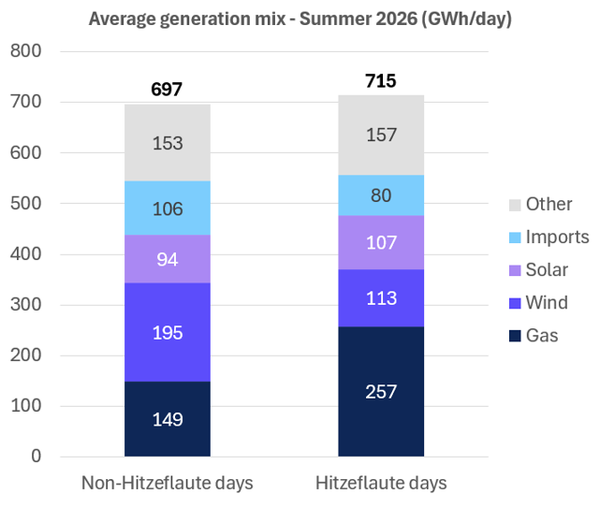
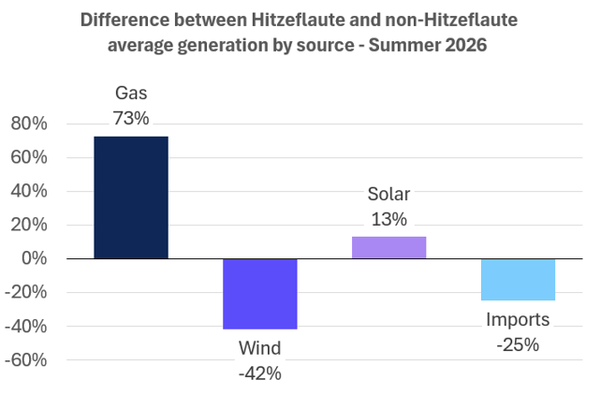
As alluded to in the charts above, wind generation plummeted on the low-wind Hitzeflaute days, producing less than 70 GWh of electricity on six days over the summer. On 16 August, wind fell to 28.9 GWh, 85% below the non-Hitzeflaute average. On 30 June, wind supplied only 79 GWh, while gas delivered 353 GWh, approximately 4.5 times as much.
Meanwhile, the hot and sunny weather meant that solar increased generation by 14% from its non-Hitzeflaute average, demonstrating its very important role during the heatwaves. However, these daily totals conceal a more complex picture around timing. Solar production is concentrated during daylight, whereas system balancing is required after sunset. This means that solar reduces daytime pressure, but dispatchable gas generation has to respond rapidly when output or demand changes quickly.
The extreme weather also squeezed electricity supplies across Europe over the heatwaves, making imports less dependable when Britain needed them most (especially on Hitzeflaute days). Heat and drought have forced nuclear plants in France, Romania and Hungary to reduce output, while lower river levels have constrained the cooling capacity of some plants. With less nuclear generation available across the continent, electricity imports through interconnectors have become more uncertain, increasing pressure on Britain’s domestic generation fleet.
2025 vs 2026
Gas played a larger role during the 2026 Hitzeflaute periods than in the equivalent periods in 2025. Average daily Hitzeflaute gas generation rose from 212 GWh in 2025 to 257 GWh in 2026, an increase of around 21%. Its share of the Hitzeflaute generation mix also increased, from approximately 31% to 36%, a rise of almost 5 percentage points. This suggests that gas was not only generating more electricity in absolute terms, but was also becoming more important relative to other sources during periods of extreme heat and low wind. This may partly reflect increasingly challenging weather conditions, with the particularly hot and low-wind summer of 2026 reducing renewable generation output and potentially impacting the reliability of interconnector infrastructure.
The peak comparison makes this shift even clearer. Maximum daily gas generation rose from 295 GWh in 2025 to 353 GWh in 2026, an increase of 58 GWh, or almost 20%. Yet total generation on the respective peak-gas days was actually lower in 2026, at 704 GWh compared with 734 GWh in 2025. In other words, the higher gas output was not simply the result of a larger overall system or higher total generation on the day. Instead, it reflected a materially different generation mix, with gas carrying a greater share of the burden when other sources were less able to meet demand.
A comparison with last year may not show a long-term trend, but it does illustrate that this phenomenon isn’t a one-off. With ever more extreme weather during summer becoming the new normal, the role of the gas system in keeping the lights on will only become more obvious.
Towards a whole-systems approach
Our analysis of the summer months shouldn’t be read as a comment on renewables. Renewables (including green gases) are essential to the decarbonisation of our energy system, and it’s right that they will be playing an ever-greater role in the years to come. What this research shows is that the likes of solar and wind power must be supported by our flexible and resilient gas infrastructure – especially as extreme weather conditions become less unusual. Whether it be winter or summer, the energy system simply doesn’t work without gas.
This shows that ministers and regulators must avoid tunnel vision when it comes to our future energy system. Rather than a sole focus on one or two technologies, a whole-systems approach that embraces all of the tools at our disposal is the only way to achieve decarbonisation and resilience simultaneously.
Government can help make this happen by progressing its Gas System in Transition programme through a full response to the security of supply consultation, publishing long-awaited frameworks for biomethane and hydrogen, and staying the course on carbon capture and storage.
Gas demand will more than likely fall in the coming years due to electrification, but the emphasis should be on decarbonising the residual gas which will have to remain, rather than attempting to electrify everything. Through new and existing technologies, gas is perfectly placed to go on enabling a renewables-led system through its flexibility and storage value, while itself helping to decarbonise the system.
The energy transition will only succeed if it keeps energy dependable in difficult weather conditions. That means recognising the continuing value of gas today, while accelerating the shift to the greener gases of the future.