
Earlier this month, industry leaders, stakeholders and parliamentarians gathered on a packed House of Commons Terrace for the All-Party Parliamentary Group for Energy Studies’ (PGES) annual Winter Warmer reception, sponsored by Future Energy Networks (FEN) and the Green Gas Taskforce (GGT).

This year’s event came following publication of the Department for Energy Security and Net Zero's long-awaited Warm Homes Plan in January. The plan focuses mainly on fully electric heat pumps (with a nod to other technologies like heat networks and heat batteries) working in tandem with solar PV as the primary route to decarbonise heat. This was packaged up as a new and pioneering plan, but in many respects, it represents a continuation of a longstanding strategy centred on electrification rather than a significant shift in approach. A longstanding strategy that simply hasn’t worked.
The plan also resets previous ambitions, introducing a new target of 450,000 heat pump installations per year by 2030 compared with an earlier target of 600,000 by 2028. Even achieving this revised target will be a formidable task, particularly within a tight fiscal environment and with a subsidy of the scale of £7,500 needed per heat pump installation under the Boiler Upgrade Scheme.
Given that earlier strategies haven’t delivered the required scale of heat decarbonisation, a new plan that largely follows the same trajectory risks falling short too. While government has expanded the Boiler Upgrade Scheme to include technologies such as heat batteries and air-to-air heat pumps, solutions that make use of existing gas infrastructure, including hybrid heat pumps, remain absent despite growing real-world evidence supporting their role[1].
These questions shaped much of the discussion at the reception. Does the Warm Homes Plan fully reflect the realities of Britain’s housing stock, energy infrastructure and consumer preferences? How can heat decarbonisation accelerate without imposing unsustainable costs or disruption? And how might the UK’s gas infrastructure contribute to practical solutions that complement electrification rather than compete with it?
A key contribution to this debate came in the form of a new report from the Green Gas Taskforce (GGT).
Bio-Hybrids: a clean heat solution
In partnership with Cadent, and working with the consultancy Guidehouse, the GGT assessed the role that biomethane-fuelled boilers combined with air source heat pumps, known as “Bio-Hybrids”, could play in decarbonising heat.
The resulting report, Green Gas Homes: Bio-Hybrids: A Clean Heat Solution, presents significant findings. Its analysis suggests Bio-Hybrid systems are the lowest-cost clean heat option for between 30 percent and 45 percent of homes today, particularly properties with EPC ratings of D, E or F, which are typically harder to decarbonise.
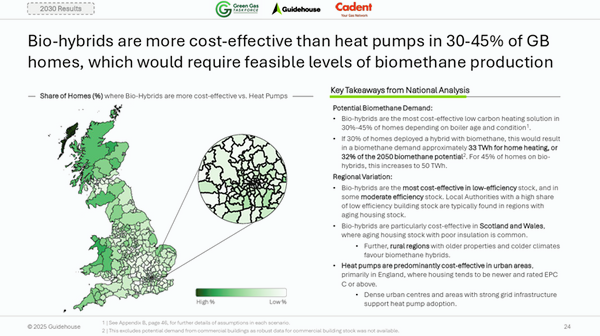
Source: Guidehouse report for the Green Gas Taskforce 'Green Gas Homes: Bio-Hybrids: A Clean Heat Solution'
Hybrid heating systems typically operate by using a heat pump to provide heat during milder conditions or when electricity prices are lower, while retaining a boiler to support peak demand and hot water needs. Smart controls allow systems to switch between electricity and gas depending on price signals, grid conditions and system demand, helping manage peak electricity loads while maintaining household comfort. When biomethane replaces natural gas, the system becomes fully decarbonised.
Affordability and accessibility
A central conclusion of the research is that Bio-Hybrids are best when used in homes that are expensive or technically difficult to electrify. By reducing the need for extensive upgrades often required for a fully electric heat pump installation, such as radiator replacements or pipework changes, hybrid systems can lower costs and provide a pathway for households with existing combi boilers.
Polling conducted alongside the report highlights the constraints many households face. When asked how they would spend £8,640, roughly equivalent to four years of typical savings and the approximate cost of upgrading an EPC D property to EPC C, only 11 percent of respondents mentioned home improvements at all, with holidays and travel ranking highest. When specifically asked about spending on home insulation, 45 percent said they would not spend anything, while a further 24 percent said they could not do so because they rent their property. Only 2 percent said they would be willing to spend the full amount required.
Heating solutions that rely heavily on high upfront costs may simply not be viable or desirable for many people, even with government support. Clean heat solutions must align with consumer behaviour as well as technical modelling.
A whole-systems approach, not a single solution
Fully electric heat pumps will continue to play a central role in decarbonising heat. However, it is becoming increasingly clear that meeting climate targets requires a different approach.
Hybrid heating systems exemplify whole-systems thinking. By combining electricity and gas, they deliver emissions reductions while supporting system resilience. They can reduce pressure on electricity networks, helping to limit the scale and cost of reinforcement required.
Importantly, biomethane is a renewable fuel that is already flowing through the gas network today. Hybrid systems have the potential to reduce bills for customers while enabling completely clean heating when powered by green gas.
Matching policy with evidence
Despite a growing evidence base, hybrid heating and green gases continue to receive limited recognition in policy frameworks. This is becoming harder to justify.
In our response to the government’s consultation on alternative clean heating solutions, we’ve made clear that excluding hybrid systems and green gases risks narrowing the range of viable options available to consumers, particularly those in harder-to-decarbonise homes.
Policy should be driven by outcomes such as emissions reduction, affordability and system resilience. An approach focused solely on electrification risks slowing progress.
Prioritising pragmatism over ideology
During the Winter Warmer, Shadow Secretary of State for Energy Security and Net Zero Claire Coutinho MP captured the essence of this challenge when she said:
“We are going to have a gas grid for a long time. To demonise a necessary part of our infrastructure and our economy shows you how far we’ve got away from pragmatism in our energy policy.”
The gas network is not a barrier to decarbonisation. It is a world class asset that can support the transition through green gases and hybrid solutions, working alongside electrification.
If we are serious about decarbonising heat fairly and affordably, policy must align with both evidence and reality.
[1] For example, the potential of hybrids to lower bills has been recently demonstrated in a trailblazing trial carried out by a consortium including Intergas Heating Ltd in the Netherlands. Their final report is here.